
Karen Benson grew up in the Olympic Village of Lake Placid, New York, where horses were a rarity—aside from the prestigious Lake Placid Horse Show that came to town each year. That changed when her mother, Mary, bought her a horse when Karen was just five years old. From that moment on, Karen was hooked.
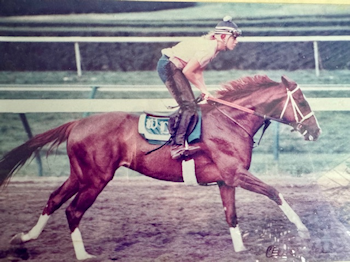 Horses quickly eclipsed her early pursuits in skiing and figure skating, and there was no turning back. She immersed herself in Pony Club and worked for top show-jumping riders whenever the Lake Placid Horse Show was in town. While employed at a show barn near Saratoga Springs, her curiosity led her to sneak onto the Saratoga racecourse backside in the early mornings to watch Thoroughbreds train. There, she crossed paths with an assistant trainer for Hall of Fame trainer Nick Zito, who offered her a job hot-walking and riding two-year-olds. Compared to the long, grueling days at the show barn, the racetrack felt electric.
For the next 13 years, Karen built a career as an exercise rider and assistant trainer for high-stakes Thoroughbred racehorses, traveling to tracks throughout New York, Kentucky, New Jersey, Pennsylvania, and Florida. She exercised horses for some of the sport’s most legendary trainers, including the late D. Wayne Lukas, with mounts competing in the Kentucky Derby, the Breeders’ Cup, and other elite races.During this time, she began purchasing off-the-track Thoroughbreds (OTTBs) who no longer fit the racing world, rehabilitating and retraining them for show jumping and other second careers—a passion that would become a defining thread in her life.
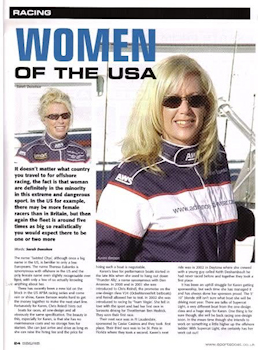 After retiring from the racetrack, Karen moved to South Florida full time, always keeping a horse to ride and compete. While working various jobs and living near Miami, she discovered an entirely new adrenaline-fueled world: offshore powerboat racing. Attending races led her to meet the late boat builder Chris Reindl, who gave her the opportunity to race at the Sarasota Offshore Grand Prix—an event in which she won her class. She went on to form an all-female racing team, raced for Aqua Toy Store and other teams, and eventually was hired as Event Coordinator for the Florida Powerboat Club.
Karen first learned about the Tryon area through friends she met in Wellington. After years of traveling back and forth between Florida and North Carolina, she sold her Wellington home and relocated to North Carolina full time. Eight years ago, she joined the Tryon Hounds as a professional riding member. She had previously capped with several hunts, including Shakerag Hounds and Hidden Hollow Hills in New Jersey. While working as a rehabilitation rider at Still Creek Farm, she met Becky Barnes, then President of the Tryon Hounds, who invited her to cap with Tryon. Karen was immediately drawn to the hunt’s professionalism, impeccable turnout, skilled Huntsman Beth Blackwell, and welcoming community. She soon became a full member, adding foxhunting to an already diverse riding portfolio that includes flat racing, trail riding, hunter paces, show jumping, hunters, field hunters, and Extreme Cowboy competitions.
Among her favorite OTTBs is Money Makes Money (“Kitt”), a standout competitor who earned numerous show-jumping awards, was named Thoroughbred Versatility Horse of the Year, and won the Field Hunter Trials representing the Tryon Hounds—capturing the $5,000 top purse at the Tryon International Equestrian Center. Another favorite is her current horse, You Betcha, who made the finals at the Retired Racehorse Project in both Show Jumping and Field Hunters at the Kentucky Horse Park in Lexington, Kentucky, and now serves as her hunt horse.
Karen believes a good foxhunter must be brave, patient, practical, and possess solid riding skills. Above all, she emphasizes good horsemanship and always doing what is best for the horse. For her, the ideal hunt horse has a “good brain”—one that learns quickly, remains unfazed by hounds and horns, adapts to reverse
fields, can gallop boldly, and then stand quietly when asked. She also values fitness, preferring horses that are consistently conditioned rather than “weekend warriors.” To that end, she often exercises horses for others between hunts, helping keep them fit or work through training.
One of Karen’s most unforgettable experiences was a South African Big Five horseback safari at Wait A Little. Rising early each day, riders bushwhacked to find game, learned tracking skills, practiced cracking a hunt whip, followed strict safety protocols, and allowed their horses to graze calmly while wildlife moved nearby. Over the course of the trip, Karen saw all of the Big Five—lion, leopard, African bush elephant, rhinoceros, and Cape buffalo. “The horses were incredibly desensitized,” Karen recalled. “There were two rhinos hanging out by the dressage arena at camp. We crossed rivers full of crocodiles, which was nerve-racking, and saw hippos—arguably the most dangerous animals when out of the water—along with cheetahs. It was truly a memory of a lifetime.” Looking ahead, Karen hopes to create another once-in-a-lifetime experience in 2026 by volunteering with the equine program at Imire Rhino & Elephant Conservation in Zimbabwe.